PIR Sensors
Cucumber PIR lighting control sensors are available for ceiling and high-bay switching and dimming applications. They can be used as standalone units or networked using mesh Bluetooth communication.
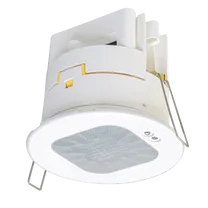
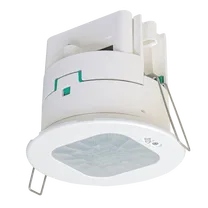
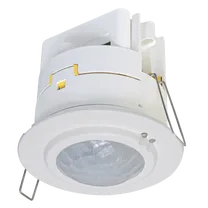
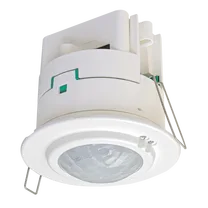
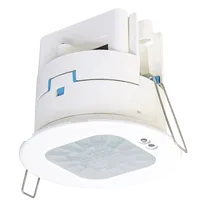
Ceiling Dimming Lighting Control Sensor - DALI Powered
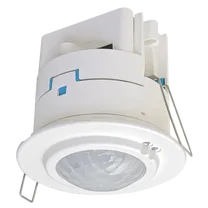
High Bay Dimming Lighting Control Sensor - DALI Powered
PIR Sensor FAQs
Frequently asked questions about pir sensors
Passive infrared sensors (PIRs) provide energy efficiency, security, and convenience by ensuring lights are not left on unnecessarily. They work for both indoor and outdoor lighting applications.
- PIRs for lighting control detect motion by measuring changes in infrared radiation emitted by people or objects within their field of view.
- Adjustable sensitivity – helping reduce false triggers
- Cost-Effective – PIR sensors are typically more affordable
- Controllable – reliable in controlled indoor spaces
- Line-of-sight detection – helping to reduce false triggering; will not trigger through:
- Glass
- Walls
- Doors - Wide detection radius (up to 36m for high bay versions)
- Low power consumption – PIRs use very little power because they don’t emit signals—they only detect heat changes. That makes them ideal for continuous operation while adding very little to energy costs.
- Reliable in controlled environments – In indoor spaces with clear lines of sight, PIR sensors are highly dependable and less prone to random triggering than more sensitive technologies.
- Fewer false triggers – Because they respond to heat from moving people, they are less likely to be triggered by air movement (fans, HVAC) or moving objects without heat.
- Passive operation (No Emissions) – Unlike microwave sensors, PIR devices don’t emit any signals. This can be preferable in environments where minimal electromagnetic emissions are desired, and Interference with other devices needs to be avoided.
- Cost-effective – PIRs are generally cheaper than microwave or dual-technology sensors, both in terms of purchase price, installation complexity and maintenance.
PIR (Passive Infrared) lighting control sensors are affordable and energy-efficient, but have several limitations:
- They require a clear line of sight and can't detect movement through walls or obstacles.
- Small movements or stationary occupants in rooms may not be detected, causing lights to turn off.
- Detection is better for sideways movement than for direct approaches.
- Performance drops in warm environments where body heat blends with the background.
- False triggers can occur from heat sources like sunlight or HVAC systems.
- Coverage and accuracy depend on proper placement.
PIR lighting control sensors are often used in areas where people come and go, helping save energy, improve security, and make lighting more convenient by automatically turning it on and off. They work best in small or medium-sized rooms where people walk across the sensor’s view instead of straight toward it.
| PIR | Microwave | |
|---|---|---|
| Sensitivity | Moderate | Very high |
| Detection through walls | No | Yes |
| False triggers | Lower | Higher risk |
| Best for | Smaller / defined areas | Large / complex spaces |

